Entering the Cloud: The Gates of Hell
Posted on February 4, 2026 • 4 min read • 817 wordsEntering the cloud is often presented as a simple modernization. In reality, it acts as a brutal revealer of technical, organizational, and human flaws. Why do so many teams describe entering the cloud as “hell”?
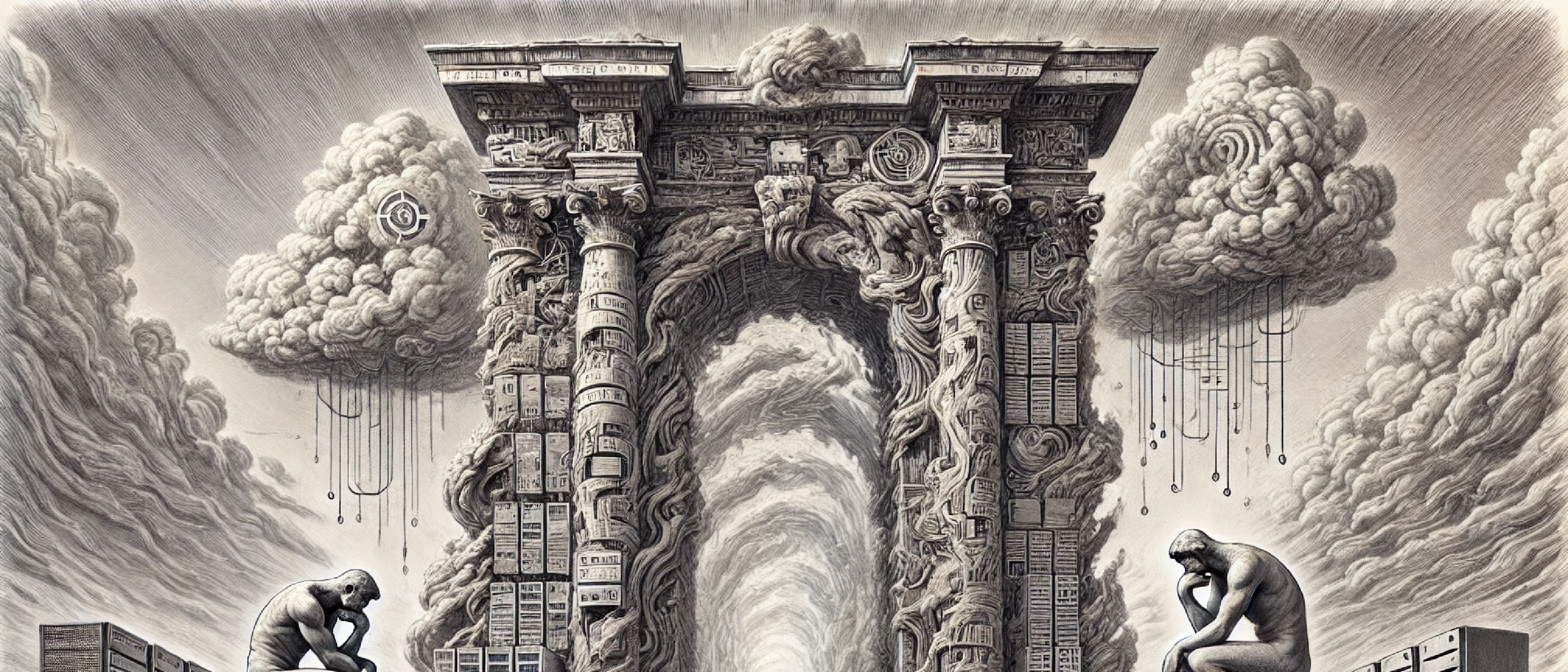
Entering the cloud is rarely experienced as a simple infrastructure change.
For many organizations, it is a brutal—almost violent—break
with their habits, tools, and mental models.
What was supposed to bring simplicity instead reveals a complexity
that had long been hidden.
And this complexity is not only technical.
I. The Call of the Cloud
The cloud always begins with a seductive promise.
Infrastructure that is instantly available, elastic, billed by usage,
and capable of adapting to any workload.
The message is reassuring: it suggests that infrastructure becomes a detail,
almost a utility service.
But this promise rests on a fundamental misunderstanding.
The cloud does not eliminate complexity; it makes it explicit, granular,
and unavoidable.
Where a datacenter hid its approximations behind physical servers, the cloud demands that every choice be formulated, configured, and owned.
II. The First Threshold: A Project
The real entry into the cloud rarely starts with a global vision.
It usually begins with a pilot project, a POC (Proof of Concept), a quick experiment.
An account is created, a few resources appear—often with default settings.
Permissions are broad, the network permissive, security minimal.
The problem is not experimentation.
The problem is that these decisions are never treated as architectural decisions.
In the cloud, nothing is neutral.
Every resource created becomes part of a dependency graph that will influence
all future choices.
III. The Circles of Hell
Cloud complexity does not reveal itself all at once.
It emerges in successive layers, each exposing a new form of fragility.
Circle 1 — IAM
IAM is almost always addressed too late.
To move fast, broad permissions are granted. Then rules, exceptions, and patches are piled on.
Gradually, no one knows exactly who has access to what. Changing a policy becomes risky, because it might break an invisible but critical system.
Poorly designed IAM does not only create security vulnerabilities. It paralyzes system evolution.
Circle 2 — Networking
Cloud networking is abstract and distributed. It operates on implicit rules and invisible relationships.
Cloud network incidents are often silent: services appear up, but traffic no longer flows.
Without a clear mental model of the network, diagnosis becomes slow, uncertain, and costly.
Circle 3 — Billing
The bill acts as a brutal reminder of reality.
Every technical decision becomes a financial decision. But without structure, costs are neither attributable nor controllable.
The pain is not the amount. It is the lack of understanding.
Circle 4 — Observability
The cloud generates a massive amount of signals: logs, metrics, events, traces.
But without intent, these signals turn into noise. Accumulating data does not create understanding.
A non-observable system turns every incident into a human crisis.
IV. The Invisible Demons
The real difficulties of the cloud are not always the ones
that cause immediate incidents.
They settle in slowly, silently, and become structural.
Cognitive Debt
In an unstructured cloud environment, system understanding relies on individual memory.
Decisions are not formalized, choices are not documented, and the real architecture exists only in the heads of a few people.
When those people leave, the knowledge disappears. The system becomes opaque—even to those operating it.
Organizational Debt
The cloud blurs traditional boundaries between teams.
Who is responsible for networking? For security? For costs? For permissions?
Without clear answers, decisions are postponed, responsibilities diluted, and tensions increase.
The cloud amplifies existing organizational dysfunctions.
Invisible Financial Debt
Unlike traditional infrastructure, the cloud allows you to deploy very quickly—but also to pay for a very long time.
Forgotten, oversized, or poorly attributed resources continue to generate costs without creating value.
Without explicit financial governance, the bill becomes a silent debt.
Irreversibility Debt
Some cloud choices create strong dependencies: managed services, specific architectures, proprietary tools.
These choices are not bad in themselves. But when made without awareness of their exit cost, they lock the organization into a single trajectory.
Hell is not dependency. Hell is not knowing it exists.
Human Debt
Finally, the cloud wears teams down.
The absence of standards, financial pressure, unclear incidents, and ambiguous responsibilities generate fatigue and frustration.
Teams spend more time surviving than building.
V. Hell Is Not the Cloud
It is tempting to conclude that the cloud is inherently too complex. That is a diagnostic error.
The cloud does not create chaos. It makes it visible.
What was tolerable in static systems becomes untenable in a dynamic environment.
VI. Climbing Back Up: Method Over Magic
Escaping hell does not come from a miracle tool.
It comes from:
- explicit architecture,
- clearly defined responsibilities,
- shared conventions,
- and assumed governance.
The cloud then becomes what it should have always been: an amplifier of good practices.
Conclusion
Entering the cloud is not opening the gates of paradise. It is crossing a threshold where everything becomes visible: choices, mistakes, costs, and gaps.
Hell is not the cloud.
Hell is entering it without method.